A package gets bought out. The award comes in under the estimate line, and someone says the estimate was high. Or it comes in over, and someone says the market moved. Either way the meeting moves on. Sometimes the estimate line is quietly overwritten with the award amount so the totals match.
Both reactions throw away some of the most useful evidence an estimate ever gets. An award is a real price for a defined scope, from a vendor who has to live with it. Set against the estimate, it tells you which parts of your pricing basis held up and which didn't, and whether the scope you estimated is the scope you just bought. The buyout comparison is how an estimate learns, but only if it's done at the right grain and every difference is settled on the record.
Compare the right two numbers
Start with which award number you're comparing. A vendor's bid total isn't the cost of the package. If the bid excluded something you'll have to buy elsewhere, or carried a quantity you know is short, what you expect to pay differs from what the vendor wrote down. That expected cost is the award's evaluated amount: the vendor's price plus the adjustments that travel with the award.
Keep both numbers. The raw vendor amount tells you what the market priced. The evaluated amount tells you what the package will cost you. A comparison that shows only one of them will misread every package with an exclusion in it.
Not every leveling adjustment belongs in the evaluated amount. A plug borrowed from another bidder's price to make two bids comparable did its job during leveling. Only the adjustments you actually expect to pay belong in the award.
Compare at the grain the estimate was built on
A package total is the wrong grain. A steel package can land right on its estimate total while hiding a connection rate well over the estimate, offset by an erection quantity the vendor carried short. The total matches, but neither number does.
Compare by WBS code and area, the same structure the estimate was priced on. If the vendor's lines don't map to your WBS, map them before you compare. Otherwise the comparison is matching labels, not scope.
Four kinds of difference
Every difference between an award and an estimate is one of four kinds, and each one tells you something different.
Rate. Same scope, same quantity, different unit price. This is the difference people expect. It reflects the market, the vendor's strategy or the estimate's pricing basis. Before calling it a market move, check the dates. A rate priced months before the award and never escalated will look low for reasons that have nothing to do with the vendor.
Quantity. The vendor carried a different quantity from the estimate. One of them is wrong, and which one matters. If the estimate's quantity is short, correct it in the next estimate version. If the vendor's is short, that's a risk on the award: a change order waiting for the first field measurement.
Scope. Something is in one and not the other. Scope that's in the estimate but not in the award is the most important line on the comparison. Either it's being bought somewhere else, or it has quietly left the project, or nobody has noticed it yet. Scope in the award but not the estimate means the estimate missed it or the vendor included more than was asked for. Either way, someone should say which.
Indirect. General conditions, bonds, insurance, mobilization and similar costs. Estimates often carry these in markups or separate packages, while vendors build them into their price. When the two sit in different places, the comparison shows a direct-cost overrun that's really an indirect cost on a different line. Settle where indirects live before you read the direct-cost differences.
Show every difference, flag the ones that matter
A threshold decides which differences need attention, not which ones get shown. Show them all. Then flag a difference when it's over both a percentage and an amount. A percentage alone flags every small line with a little noise in it. An amount alone flags every large line that moved a fraction of a percent. Both together point at the differences worth someone's time.
Settle every flag on the record
A flagged difference ends in one of two ways.
The estimate was wrong, so you change the estimate. Do it in the next version, with the reason, so the next comparison starts from a corrected basis.
Or the estimate stands, and the difference gets a disposition with a written reason. The usual ones are an accepted difference (the market priced it differently and the estimate basis still holds), out of scope (the difference concerns work outside what this estimate covers), a duplicate (it's already carried somewhere else), or a scope gap (in the estimate, missing from the award, and needing an owner).
What the comparison shouldn't do is change the estimate by itself. The estimate records what the team believed, on what basis, at that version. The award is evidence against it. If the award overwrites the estimate line, the evidence and the belief become the same number, and nobody can see what was learned. Keep the estimate, keep the award, and keep the reason that connects them.
What the comparison feeds
Done this way, a buyout comparison produces three things worth keeping:
- Scope gaps with owners. Each one goes on the change or risk register, with a cost, before it turns up as a surprise.
- Rate evidence. Confirmed rates, at their own dates, are the best input the next estimate's pricing basis will get.
- Quantity lessons. A consistent quantity difference on one kind of work says something about your takeoff practice, not about the vendor.
There's one thing it doesn't produce: a forecast for the packages not yet bought. A favorable buyout on steel says nothing about the electrical package. Treat each comparison as evidence about its own scope.
Where the software fits
Jakten Quote levels the bids for a package against your takeoff, and a person records the award with the adjustments that travel with it. Publishing the award gives Jakten Assurance a versioned record: the awarded lines as the award recorded them, with those carried adjustments. A published award doesn't change. A new award supersedes it and becomes the next version.
In Assurance, the award appears on the package in the Should-Cost Register. The comparison lists each WBS and area with the estimate, the award's evaluated amount and the vendor's raw amount, and flags rate, quantity, scope and indirect differences that are over the threshold on both the percentage and the amount. Every difference is shown. A flag is settled either by changing the estimate or by a disposition (accepted difference, out of scope, duplicate or scope gap) with a required reason. The comparison never changes an estimate value.
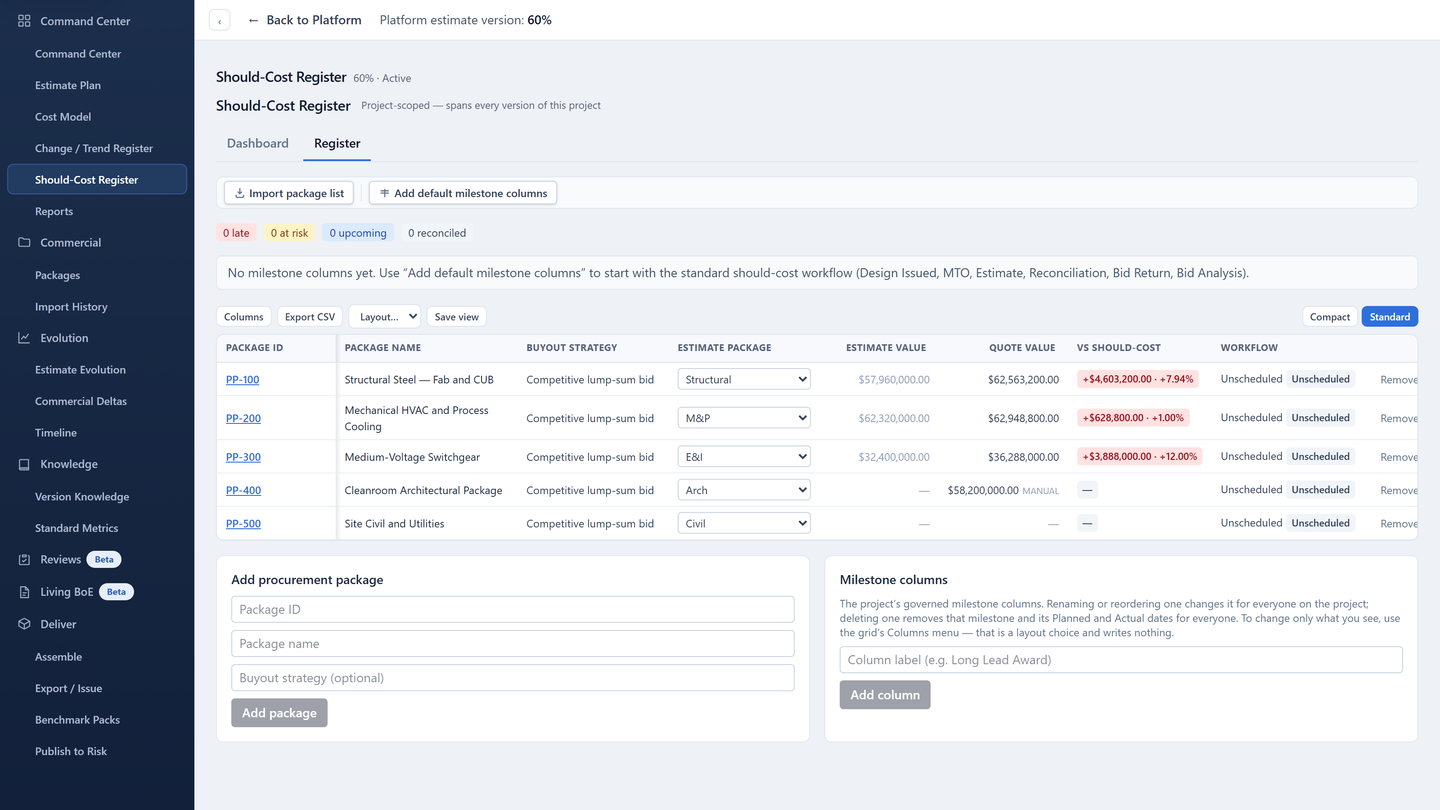
The Jakten Quote page has a short demo on a fictional project's structural steel package.